
When organizations invest in energy efficiency projects, the conversation usually starts with projected savings: lower utility bills, reduced operating costs, improved building performance.
But one of the most important questions is often left unanswered: How do you know those savings actually happened? In comes Measurement and Verification (M&V).
While many energy efficiency providers estimate potential savings before a project begins, not every provider continues measuring performance after installation. Without an established process to validate results, organizations are left relying on projections rather than proof.
For facility managers, CFOs, and property owners, understanding Measurement & Verification is essential not only for confirming financial returns, but for ensuring a building continues performing as intended for years to come.
What Is Measurement & Verification (M&V)?
Measurement & Verification (M&V) is the process of planning, measuring, collecting, and analyzing data to verify and report the energy savings achieved through energy conservation measures (ECMs). Instead of relying solely on engineering estimates, M&V compares measured energy use before and after the installation of the Ecosave solution(s) while accounting for changes in operating conditions, weather, occupancy, and other relevant variables.
The Industry Standard: IPMVP
Across the energy efficiency industry, the most widely recognized framework for Measurement & Verification is the International Performance Measurement and Verification Protocol (IPMVP).
Developed by the Efficiency Valuation Organization (EVO), IPMVP establishes standardized methods for calculating and verifying energy savings across a wide range of building types and energy projects.
By following an accepted industry protocol, organizations can have greater confidence that savings calculations are transparent, repeatable, and credible for financial stakeholders, facility teams, and executive leadership.
Why Measurement & Verification Matters
Every energy efficiency project is built around expected outcomes. Whether the objective is reducing utility costs, lowering carbon emissions, replacing aging infrastructure, or improving operational efficiency, these are typically justified by projected savings.
But buildings are dynamic… occupancy changes, weather varies, operating schedules evolve, equipment naturally loses efficiency over time. Without ongoing verification, organizations may never know whether their systems are continuing to deliver the performance they paid for.
Measurement & Verification provides the transparency needed to answer critical questions such as:
- Are we achieving the savings we expected?
- Is our equipment still operating efficiently?
- Has building performance changed over time?
- Are there opportunities to improve operations even further?
Rather than relying on assumptions, organizations gain measurable data that supports smarter operational and financial decisions.
Not Every Energy Efficiency Project Includes Measurement & Verification
One of the biggest misconceptions in the industry is that every energy project automatically includes M&V. Many providers present estimated savings during the proposal process but stop measuring performance once installation is complete.
Some organizations receive a commissioning report. Others receive projected ROI calculations. Few receive ongoing verification of actual savings year after year.
Without a solution Measurement & Verification program:
- Equipment performance issues can go unnoticed
- Savings may gradually decline over time
- Financial assumptions become difficult to validate
- Building owners lose visibility into long-term performance
- Avoidable maintenance costs are spent
If savings aren’t being measured, they’re difficult to prove.
How Ecosave Uses Measurement & Verification
At Ecosave, Measurement & Verification isn’t treated as the final step of a project, it’s an ongoing process that supports continuous building performance.
Using our cloud-hosted energy management and building performance platform (EcosaveWatchTM), we collect and analyze data from building automation systems, equipment, utility meters, and utility providers to deliver a comprehensive view of facility performance.
Our engineering team uses this data to:
- Verify actual energy savings against project expectations
- Identify operational inefficiencies and optimization opportunities
- Validate reductions in operating costs and net operating expenses
- Support sustainability and emissions compliance reporting
- Document long-term project performance through annual Measurement & Verification reporting
- Capture incentives, investment tax credits and other funding
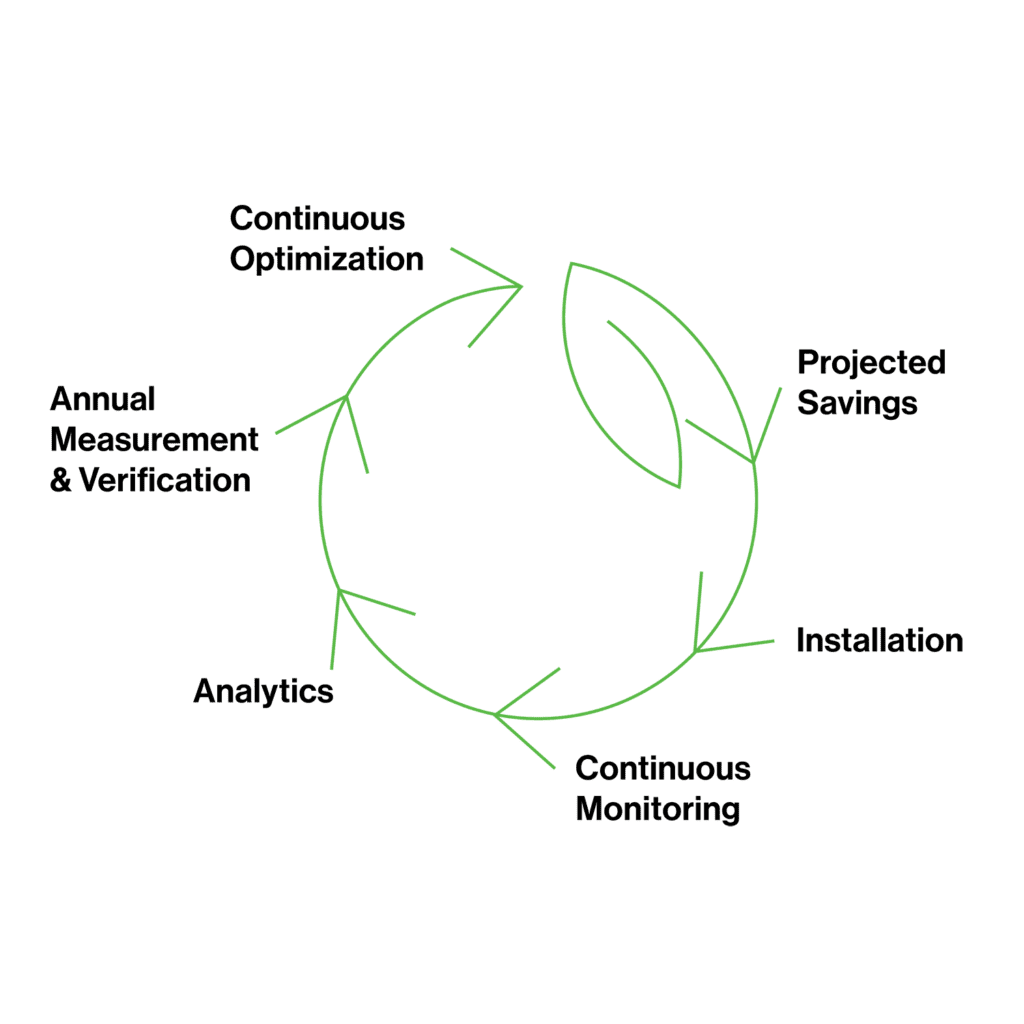
EcosaveWatchTM seamlessly connects to your existing building systems, equipment, and utility data, providing ongoing visibility into building performance and helping identify new opportunities for efficiency throughout the life of the project. For more information on real-time insights and reporting, click here.
Questions to Ask Before Choosing an Energy Partner
If you’re evaluating an energy efficiency solutions partner, ask these important questions:
- How will savings be measured after the project is complete?
- Do you follow an industry-recognized M&V protocol such as IPMVP?
- Will we receive annual Measurement & Verification reports?
- How do you validate financial savings?
- What happens if building performance changes over time?
- Will we have visibility into ongoing system performance?
The answers can reveal the difference between a provider that simply installs equipment, and a solutions partner that remains accountable for long-term results.
The Bottom Line
Projected savings are valuable. Verified savings are even better.
Measurement & Verification provides the transparency, accountability, and confidence organizations need to understand how their buildings are performing and whether infrastructure investments are delivering the expected return.
As energy costs continue to rise and organizations face increasing pressure to reduce operating expenses and modernize aging facilities, choosing a partner that measures, verifies, and continuously optimizes performance can make all the difference to optimally execute on your cost mitigation plan. Because when delivering energy efficiency, the numbers that matter most aren’t the ones in the proposal, they’re the ones you can prove.